
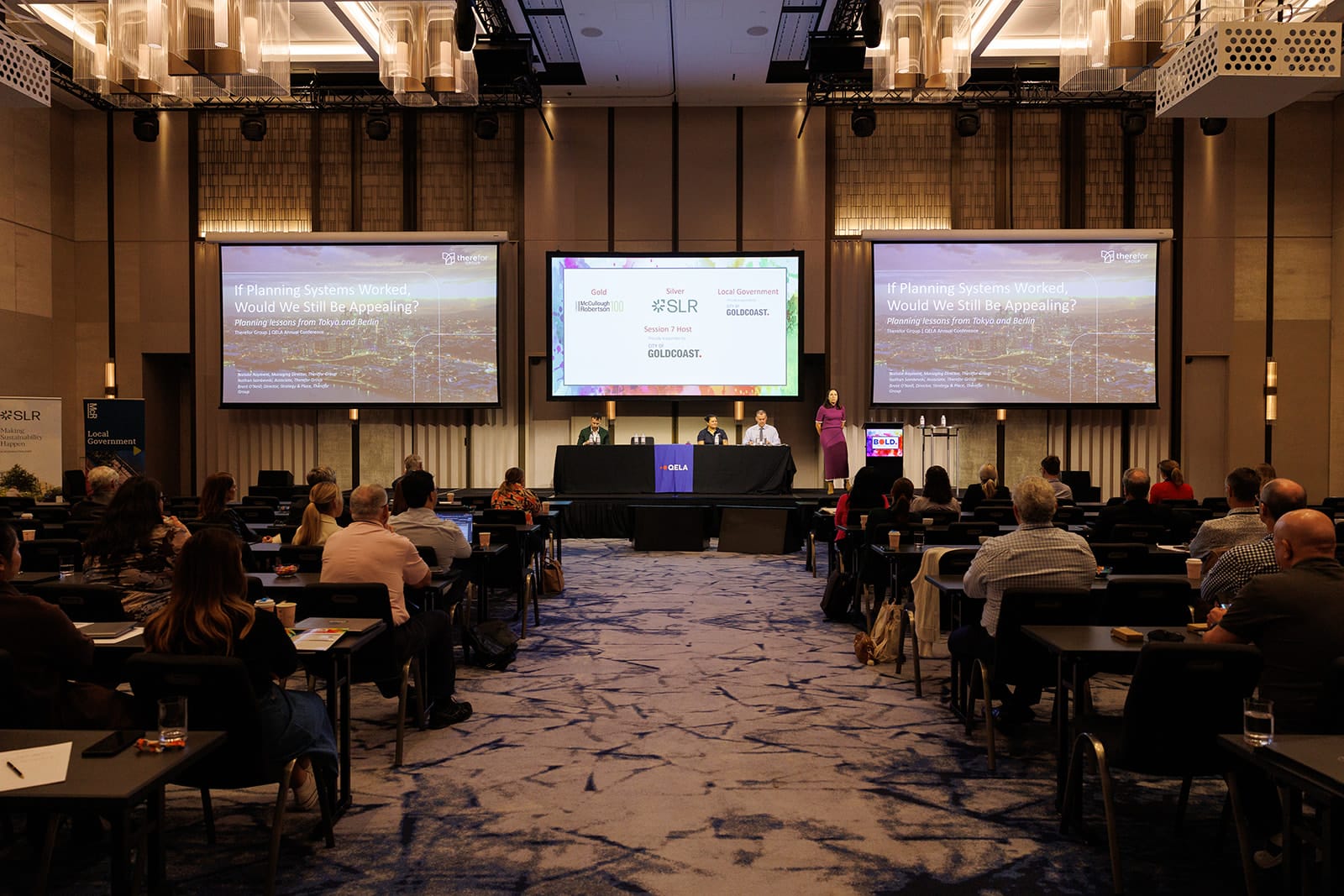

If appeals are a routine part of the planning practice in Queensland, what does that tell us about where our system chooses to resolve planning conflict?
It’s no secret that our state is in the midst of a housing crisis, with a need to build 49,300 new homes per year across Queensland – a goal we’re consistently falling short of.

During a visit to Berlin last year, it caught our attention that while it’s a different culture, at a different scale, with different housing types, needs and challenges, the headlines were the same. Across Europe and the US, there’s a high need for new dwellings that isn’t being met.
However, one mega city stands out with a different story – Tokyo.
It has routinely added more than 100,000 new dwellings per year while continuing to attract population growth, including young professionals from across Japan. Rather than constantly playing catch-up, that sustained delivery has allowed Tokyo to build ahead of demand, creating a degree of supply ‘slack’ in the housing market.
So, when housing need has escalated across the globe, what is it about the different planning systems that affects the delivery of new housing?
The question isn’t if Queensland has too much planning regulation or if other systems don’t have enough, but rather – what role does discretion play?
Brisbane operates within a performance-based planning framework, where zones, overlays and assessment benchmarks are applied through development assessment. While this provides flexibility, it also makes it harder to see intended outcomes. This creates a system where the conflict sits at the back end with the planning scheme starting the conversation, but the development application, submissions, negotiations, expert evidence and appeal often finish it.

Tokyo’s planning framework, however, makes more of the likely urban outcomes visible before an application is lodged. The approvals system more directly communicates what forms of intensity, mix of uses and building outcomes are broadly expected. Compared to our more performance-based system, this reframes the approval question from rearguing broad planning merit to whether the proposal fits within an understood set of parameters.
Alternatively, Berlin is heavily planned, but more of the conflict is resolved before individual approvals are sought. The lesson from Berlin is not less regulation, it’s earlier resolution. Strong regulation can still produce certainty where the heavy lifting is done through plan-making before individual approvals are sought. Berlin uses binding land-use plans to settle more of the planning debate upfront with discretion settled when the rules are made or changed.
The fight does not disappear, but a better system chooses a better time and place for that fight to happen.
Instead of asking lawyers and experts to resolve too much uncertainty after lodgement, or after an appeal has commenced, there is real value in bringing that thinking into plan-making, policy design, development strategy and early risk resolution.
The hard questions do not disappear. Questions about character, density, amenity, need, environmental impacts and community expectations will always need to be answered. The issue is whether they are answered late, when everyone is already locked into a dispute, or earlier, when they can shape clearer rules and better expectations.
So, the fight does not disappear, it moves earlier.
If we only look within our own system, late conflict can start to feel inevitable, but the way we structure our planning system is not the only way.
There are models across the world – such as Tokyo and Berlin – which make other possibilities visible.
It would be impossible to copy Tokyo and Berlin exactly. We have different legislation, different expectations around public participation, different environmental frameworks and a different legal culture.
There are however several key takeaways that we could adopt, including:
- Making intended outcomes more visible upfront
- Giving planning schemes clearer practical consequences
- Moving more of the ‘heavy-lifting’ into plan making
- Creating more genuine as-of-right pathways where compliance produces real certainty
- Reducing reliance on project-by-project discretion as the ordinary way of resolving major planning questions
In short: heavy lifting at the front, better outcomes at the end, and less conflict in between.
In our opinion, Queensland’s performance-based planning system has had its time in the sun. Where Queensland is going, housing delivery will need more than yesterday’s planning settings.

CO-AUTHORS: Natalie Rayment, Managing Director and Nathan Sambevski, Associate – Planning